Estimating the return on investment for an Ontario cottage rental requires more than calculating peak summer rates. Gross income, operating expenses, vacancy rates, capital costs, and property appreciation all contribute to the real number. This guide walks through each component of a realistic ROI calculation, the factors that most affect returns in Ontario’s cottage market, and how professional management directly improves the income side of the equation.
Why Cottage Rental ROI Is More Complex Than It Appears
Many cottage owners approach their rental income estimate by multiplying their weekly rate by the number of weeks they expect to book. The result is an optimistic gross income figure that rarely survives contact with actual operating costs, vacancy periods, and unexpected maintenance. A realistic ROI calculation requires a complete picture of both income and costs, including the costs that are easy to overlook in the planning stage.
Cottage Vacations manages more than 400 properties across Muskoka, the Kawarthas, Haliburton, Georgian Bay, and beyond. Our team works with owners at all experience levels, from first-time hosts to established investors, to build income projections that reflect real market conditions rather than best-case assumptions. Owners who want a property-specific income assessment can connect with us through the rent your cottage intake process.
The Components of a Realistic Cottage Rental ROI Calculation
Gross Annual Rental Income
Gross rental income is the total revenue collected from guests before any expenses are deducted. For an Ontario cottage, this figure is driven by nightly or weekly rate, occupancy rate across all seasons, and any additional fees collected from guests such as cleaning fees or pet fees. Properties in high-demand regions such as Lake Muskoka or Lake Rosseau typically achieve higher gross income than comparable properties in lower-demand areas, both because of stronger nightly rates and because demand supports higher occupancy across a longer booking season.
Building a realistic gross income estimate requires comparing active listings of similar properties in the same region rather than relying on platform averages, which are influenced by the full range of property quality. Cottage Vacations provides prospective owners with comparable income data from our active managed portfolio, which reflects professionally managed properties rather than the full market mix.
Annual Operating Expenses
Operating expenses are the recurring costs of running a rental cottage. They include property management fees if a management company is engaged, cleaning and laundry service between each guest stay, utilities including electricity, water, internet, and propane or natural gas, landscaping and seasonal property maintenance, insurance rated for short-term rental use rather than personal use only, municipal property taxes and any applicable accommodation taxes, and marketing or platform listing fees for self-managed properties.
A common planning error is to model management fees as an expense to be avoided and self-management as a cost saving. In practice, self-managed properties typically experience higher vacancy rates, more guest disputes, and more deferred maintenance than professionally managed properties, all of which reduce net income. The management fee from a professional agency like Cottage Vacations is often offset by improved occupancy, stronger nightly rates, and reduced owner time investment.
Net Operating Income
Net Operating Income, or NOI, is gross rental income minus annual operating expenses. This is the annual profit the property generates before debt service and capital expenditures. NOI is the figure most useful for comparing the performance of different properties and for demonstrating rental income to a lender in a mortgage application. A property with strong gross income but high operating expenses may produce a lower NOI than a less prominent property with tightly managed costs.
Capital and Occasional Expenses
Capital expenses are the larger, less frequent costs that fall outside routine operating expenses. They include major repairs such as roof replacement, dock rebuilding, or septic system maintenance, furniture and appliance upgrades, deep seasonal cleaning, and any structural improvements. These costs are often underestimated in initial ROI models because they do not occur annually and can be difficult to predict. Setting aside a reserve of five to ten percent of gross rental income annually for capital expenses is standard practice for owners who want to maintain consistent ROI over a multi-year horizon.
Vacancy Rate
Vacancy rate is the percentage of available booking nights during the year that go unbooked. For an Ontario cottage, vacancy in peak summer weeks is typically low for well-managed properties in strong markets. Shoulder season vacancy is where the difference between professionally managed and self-managed properties is most pronounced. Properties managed by Cottage Vacations benefit from active shoulder-season marketing, dynamic pricing that adjusts to demand conditions, and a database of more than 35,000 verified returning renters who book across all seasons.
Property Appreciation
Property appreciation is the long-term increase in the market value of the cottage. In high-demand Ontario lake markets such as Lake Muskoka, Lake Rosseau, and Lake Joseph, waterfront properties have shown consistent appreciation over the past decade that, when factored into total investment return, meaningfully improves the overall ROI picture. Appreciation cannot be counted as cash flow, but it is a real component of investment return that should be included in any multi-year ROI analysis.
How to Calculate Your Cottage Rental ROI
Step One is to estimate gross annual rental income based on comparable market data for similar properties in your region. Step Two is to list all annual operating expenses in full, including management fees, cleaning, utilities, insurance, taxes, and maintenance. Step Three is to subtract total operating expenses from gross income to produce your Net Operating Income. Step Four is to estimate an annual capital expense reserve, typically five to ten percent of gross income. Step Five is to calculate ROI using the formula: NOI minus annual capital reserve, divided by total investment including purchase price and major renovations, multiplied by 100. The result is your annual ROI percentage before debt service.
The Factors That Most Affect Cottage Rental ROI in Ontario
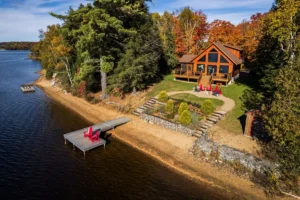
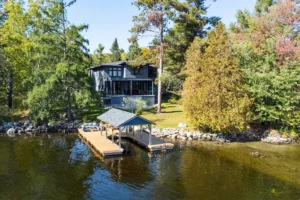
Location is the strongest single variable. Lakefront properties on high-demand lakes command higher weekly rates and fill more consistently than comparable properties on less prominent lakes. Within a region, the specific lake, the direction the property faces, and the distance from the nearest community all affect both nightly rate and occupancy. Properties that are waterfront rather than deeded access to water also achieve meaningfully higher rates and are easier to market to premium renters.
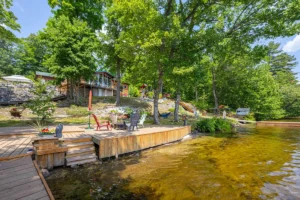
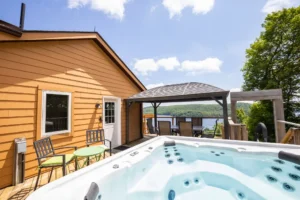
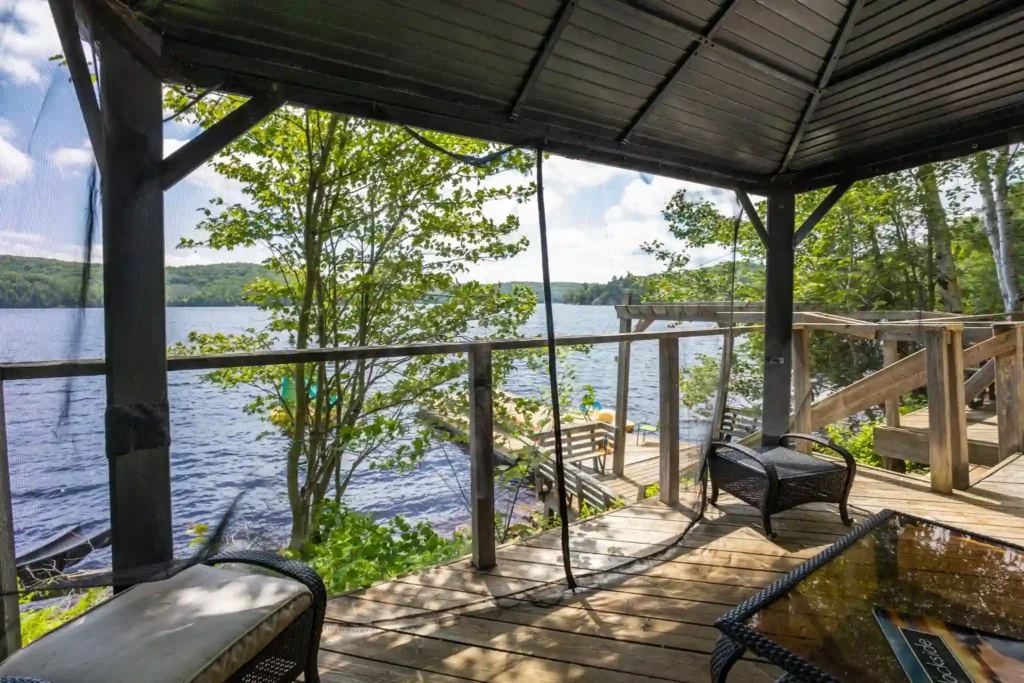
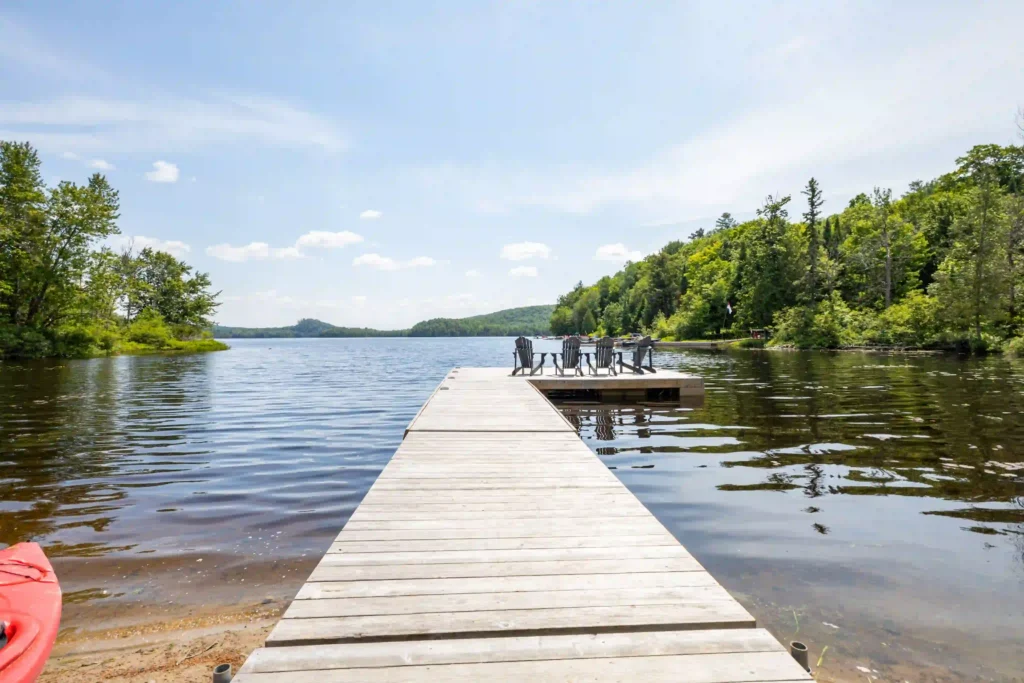
Amenity profile is the second strongest variable. Properties with hot tubs, private docks, watercraft, and high-speed internet consistently generate more bookings at stronger rates than properties without these features. Hot tub cottages in particular attract early bookings from renters who treat these amenities as a filter, not a bonus. Pet-friendly designation also expands the available renter pool significantly without major cost to the owner.
Management quality is the third strongest variable. A premium property with weak management will underperform a comparable property with strong management in the same market. Cottage Vacations’ management model is built to maximise the income potential of every property we manage, regardless of its price point. Owners on our program consistently outperform regional self-managed averages. Owners who want to understand what that means for their specific property can request a performance comparison through Cottage Vacations.
How to Strengthen Your Cottage’s ROI Over Time
Professional photography and an accurately written, fully disclosed listing description are the baseline requirements for competitive listing performance. Properties that are represented with high-quality images and honest, detailed descriptions convert browsers to bookings at a higher rate than those with amateur photography or vague descriptions. Cottage Vacations coordinates professional photography for all properties in our managed portfolio as part of the onboarding process.
Targeted amenity upgrades generate returns faster than general property improvements. Adding a pet-friendly designation, upgrading internet to high-speed, or adding a hot tub each expands the renter pool and supports a rate increase. The upgrades that generate the strongest return vary by region and existing property profile. Cottage Vacations advises owners on which investments are most likely to improve booking performance in their specific market before any capital is committed.
Frequently Asked Questions
1. What is a realistic ROI for an Ontario cottage rental?
Most owners of professionally managed Ontario cottage rentals achieve net returns between four and eight percent annually, excluding property appreciation. Premium waterfront properties on high-demand lakes such as Lake Muskoka or Lake Rosseau typically achieve the upper end of that range. Properties in lower-demand areas or those with higher vacancy rates may achieve lower returns. The single most reliable way to improve ROI is to improve management quality and occupancy consistency rather than to raise nightly rates.
2. How does vacancy rate affect my cottage’s ROI calculation?
Vacancy is one of the most significant and most underestimated factors in cottage rental ROI. A property that achieves a 20 percent higher nightly rate but operates at 60 percent occupancy will generate less income than a comparable property with a lower rate at 80 percent occupancy. Consistent, year-round occupancy management through active marketing, dynamic pricing, and a strong returning guest base is more valuable than peak-season rate maximisation alone.
3. Should I include property appreciation in my cottage ROI calculation?
Yes, but separately from cash flow ROI. Property appreciation is a real component of total investment return and should be factored into any multi-year analysis, particularly for properties on high-demand lakes where waterfront land is scarce and values have appreciated consistently. However, appreciation cannot be used to cover carrying costs and should not be relied upon to justify a cash-flow-negative investment without a clear plan for how costs will be covered during the holding period.
4. How do I estimate gross rental income before I purchase a cottage?
Request comparable rental performance data for similar properties in your target area from a management company that operates in the region. Cottage Vacations provides prospective buyers with market-comparable income data from our active managed portfolio upon request. This data reflects the performance of professionally managed properties and provides a more reliable baseline than platform averages, which include self-managed and poorly maintained listings. Connect with our team through rent your cottage to request a pre-purchase income assessment.
5. Does professional management actually improve ROI after fees are deducted?
For most owners, yes. The management fee is offset by improved occupancy rates, stronger nightly rates achieved through professional pricing strategy, reduced vacancy from active marketing and a returning guest database, and lower incident costs from professional guest screening and property care. Self-managed properties frequently leave money on the table through avoidable vacancy, underpricing in peak periods, and deferred maintenance that reduces guest satisfaction and review scores.
6. What capital expenses should I reserve for as a cottage rental owner?
Standard practice is to reserve five to ten percent of annual gross rental income for capital expenses. This reserve covers major repairs such as dock replacement, roof maintenance, septic service, and appliance replacement that occur infrequently but can be costly. Owners who do not maintain a capital reserve are frequently caught by these expenses at the worst time, reducing net income in the year the expense occurs and sometimes disrupting the rental season if repairs require the property to be taken off the booking calendar.
Key Takeaways
- A realistic ROI calculation requires gross rental income, annual operating expenses, net operating income, a capital expense reserve of five to ten percent of gross income, vacancy rate, and property appreciation. Peak-rate multiplication is not a calculation.
- Vacancy rate is one of the most underestimated variables in cottage rental ROI. A lower nightly rate at 80 percent occupancy generates more income than a higher rate at 60 percent occupancy. Consistent year-round occupancy management outperforms peak-season rate maximisation.
- Self-management is not a cost saving. Self-managed properties typically experience higher vacancy, more guest disputes, and more deferred maintenance than professionally managed properties, all of which reduce net income below what the management fee would have cost.
- Location and amenity profile are the two strongest variables after management quality. Waterfront properties on high-demand lakes command higher rates and fill more consistently. Hot tub designation and pet-friendly access each meaningfully expand the available renter pool.
- Property appreciation is a real component of multi-year investment return and should be included in any long-term ROI analysis, particularly for waterfront properties on high-demand Ontario lakes where supply is structurally constrained.