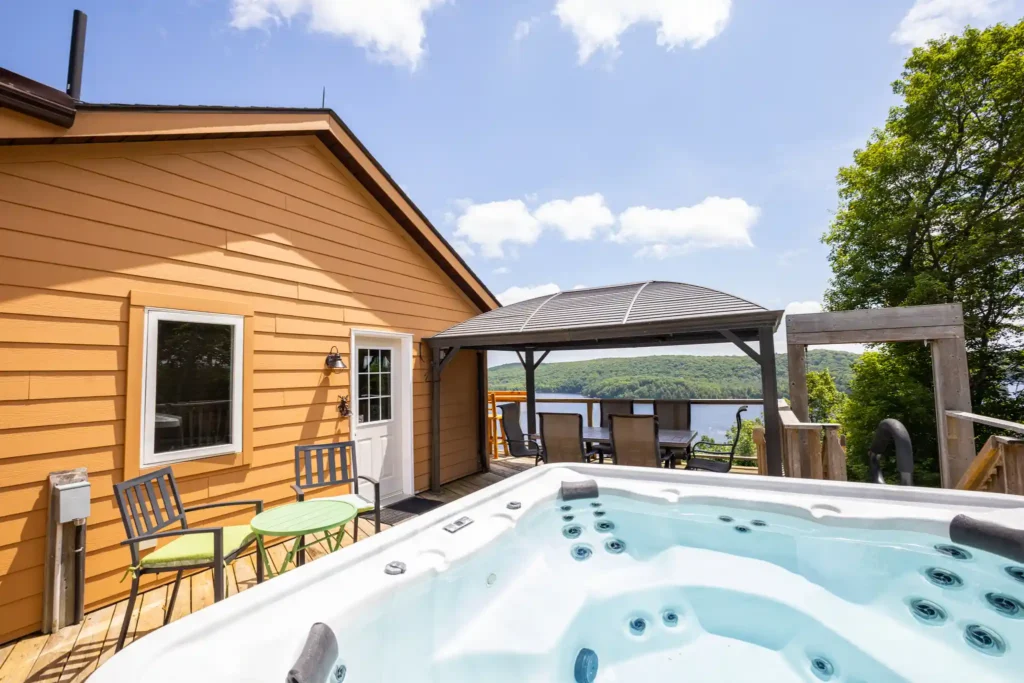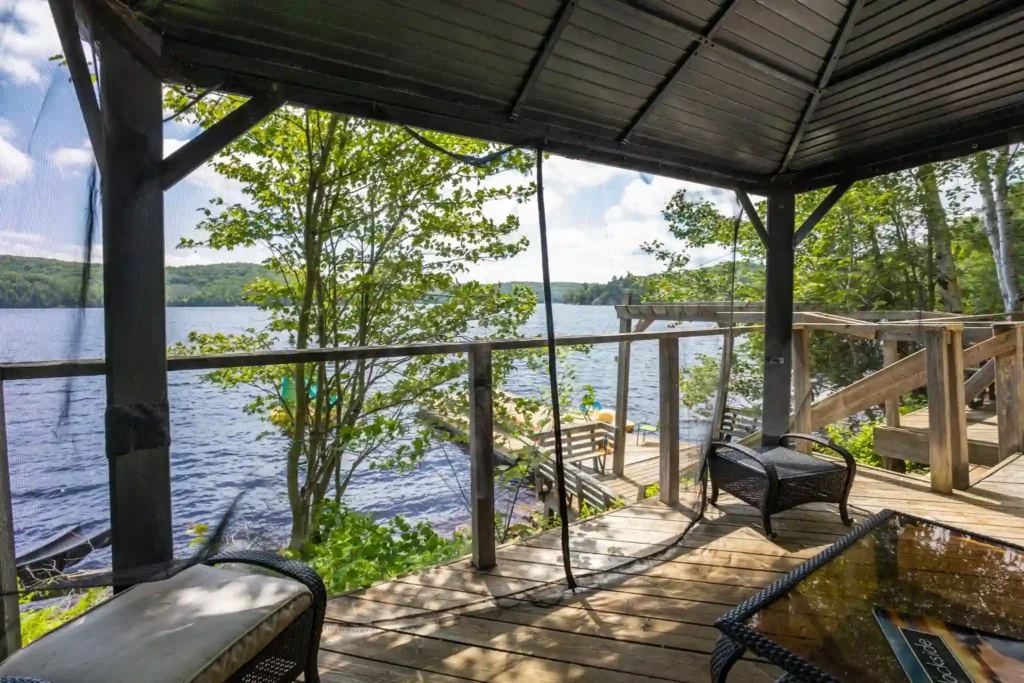
Sterling Point is one of the most accurate depictions of Muskoka cottage life to appear on television. The dock rituals, the generational property dynamics, the class tensions, the community rhythms of a small lake village, all of it is drawn from real observation and lived experience. At the same time, it is still a television series. Certain elements are compressed, softened, or aesthetically elevated in ways that real cottage life simply is not. This post goes through both columns honestly: what the show gets exactly right, and where it romanticises the experience for the screen.
Why Does Sterling Point Feel So Accurate to People Who Know Muskoka?
The first thing longtime Muskoka cottagers tend to say about Sterling Point is that it feels true in a way most cottage-country productions do not. That credibility comes directly from creator Megan Park’s decision to draw the show from personal memory and documented research rather than from a generic television version of lakeside summer life.
Park spent childhood summers in Muskoka during the 1990s. She and her production team spoke at length with people who had held family properties in the district for generations, with year-round residents, and with locals who had watched the character of communities like Port Carling and Bala shift over the past two decades. That research shows. The show’s social dynamics, its physical details, and its emotional rhythms reflect the actual texture of Muskoka summer life rather than a curated version of it.
The result is a show that people familiar with the region recognise and people unfamiliar with it find immediately compelling. Both reactions point to the same thing: Sterling Point is grounded. The question this post examines is how grounded, and where the ground gives way to television.
For those planning a first visit to the region the show depicts so vividly, Cottage Vacations has operated in Muskoka since 1999. Browse the full Muskoka cottage collection to find a property that puts you inside the world the show draws on.
What Does Sterling Point Get Exactly Right About Muskoka Cottage Life?
The dock is the centre of everything
Every Muskoka cottage with direct waterfront access organises daily life around its dock, and Sterling Point depicts this with complete accuracy. Mornings begin on the dock with coffee. Afternoons are structured around swimming off it, fishing from it, or simply sitting at the end of it with feet hanging over the edge. Conversations happen on the dock that would not happen anywhere else. The dock is not an amenity; it is the room where the most important parts of cottage life occur.
The show renders this consistently across all eight episodes. Characters retreat to the dock when they need to think, connect on it when they need to talk, and use it as the natural setting for the kind of unhurried moments that cottage life produces. Anyone who has spent time at a Muskoka property will recognise this immediately. The dock functions exactly as depicted.
The pace of time changes
Sterling Point is accurate about one of the most distinctive qualities of cottage life: the way time reorganises itself once you arrive at the lake. Tasks that would take fifteen minutes in a city expand into unhurried experiences. A trip to the village for groceries becomes a two-hour event involving a stop at the marina, a conversation with someone at the dock, and a slow drive back along a lake road. Meals take longer to prepare and longer to eat. Evenings stretch past the point when city habits would normally send people to bed.
This compression of the ordinary into something slower and more deliberate is one of the most universally recognised qualities of Muskoka summer life, and the show captures it without making it feel staged. Characters are not rushing through their days. The pace of the series itself adjusts to reflect how time actually moves when the dock is outside and the lake is there.
The generational weight of an inherited property
The central premise of Sterling Point, Annie inheriting a cottage she has never visited from a grandfather she never knew, is built on something that is entirely real in Muskoka: the enormous emotional and social weight that attaches to a multi-generational waterfront property. These are not simply houses. They are places where decades of family ritual have accumulated, where the furniture has not changed in thirty years, where the dock has been repaired by the same hands that repaired it before, and where arriving for the summer carries meaning that does not need to be explained because everyone already understands it.
The show handles Annie’s encounter with this weight sensitively and accurately. Her disorientation on arrival, her gradual recognition of what the place means to the people who have been coming there, and her negotiation between her own sense of ownership and the deeper claims of continuity, all of it reflects a real dynamic that plays out in Muskoka communities whenever a property changes hands or passes to a generation that did not grow up there.
The Cottage Vacations classic cottage collection includes properties with exactly this kind of history and character, for guests who want to experience the older, lived-in end of the Muskoka inventory.
The social divide between locals and cottagers
One of the most accurate things Sterling Point does is depict the social stratification of a Muskoka community without flattening it into a simple rich-versus-poor narrative. The show distinguishes between year-round residents, long-standing seasonal families, and the newer wave of wealthy buyers who arrive with different expectations and deeper pockets. These groups exist in genuine tension in real Muskoka communities, and the show’s portrayal of that tension, particularly through the relationship between Ramona and Annie, reflects documented and ongoing dynamics in the district.
Park has spoken publicly about the economic pressure on long-standing cottage owners, some of whom must rent their properties during peak summer weeks to cover rising land taxes, which means they are absent from the place they have maintained for generations at the very time the region is most alive. This specific detail appears in the show in a way that viewers familiar with Muskoka will recognise as accurate and viewers unfamiliar with it will find it illuminating.
The lake village as a self-contained world
Sterling Point accurately depicts the way a Muskoka lake community functions as a small, self-referential world during the summer season. The marina is the social hub. The general store and the local cafe are meeting places with regulars and social hierarchies. Everyone knows everyone else’s boat. Gossip and community knowledge travel quickly across the water. Newcomers are noted. The distinction between people who belong and people who are just visiting is clear to everyone involved, even when it is never stated explicitly.
Port Carling, the real village whose streets and locks appear throughout the series, has exactly this character. Walking through it during a July weekend, you encounter a community that has its own rhythms, its own long-standing relationships, and its own way of orienting itself around the water. The show captures that accurately.
To experience the Port Carling community atmosphere during a Muskoka stay, Cottage Vacations lists properties near Port Carling that put guests within easy reach of the village and the lakes it connects.
Multi-generational family dynamics under one roof
Sterling Point is essentially a story about what happens when people who share biology but not history have to occupy the same physical space for an extended period. The cottage setting makes this acutely Muskoka-specific, because the cottage is exactly the kind of place where those dynamics surface. Away from city routines and distractions, at a property that carries its own emotional weight, family tensions and connections that would otherwise be managed at a distance have nowhere to go except into the open.
Any family that has spent more than a few nights together at a lake property will recognise this dynamic. The show uses it as a structural engine throughout the series, and the setting makes it credible in a way that a hotel or an urban apartment simply would not.
For groups planning a multi-family Muskoka stay, the multi-family cottage collection covers larger properties with the bedroom count and communal space for extended families across several days.
What Does Sterling Point Romanticize About Muskoka Cottage Life?
The weather is never difficult
Real Muskoka summer weather includes thunderstorms that arrive fast and stay for two days, stretches of grey overcast that keep the water uninviting, black fly season in late spring that can make outdoor time genuinely unpleasant, and nights cold enough in June and September to require heating. Sterling Point depicts a Muskoka summer that is essentially always golden: warm light, calm water, clear skies, and the kind of atmospheric perfection that real lake weather delivers perhaps thirty or forty percent of the time.
This is a universal television convention rather than a specific failure. No eight-episode drama about summer cottage life is going to spend significant screen time on rain. But it is worth noting that the Muskoka summer on screen is appreciably more consistent than the one you will actually experience, and that the difficult weather days are part of what makes the good ones feel earned.
The cottage is always ready
Opening a real Muskoka cottage at the start of the season involves a list of tasks that the show does not acknowledge: reconnecting the water lines, checking the dock for winter damage, dealing with the mice that inevitably found their way in, clearing the winter detritus from the deck, and diagnosing whatever the cold has done to the plumbing or the roof. Cottage maintenance is a genuine and ongoing part of the Muskoka experience, and it is part of what gives long-standing cottage families their particular sense of ownership and investment.
Gordon’s cottage in the show, when Annie arrives, is in perfect condition. It is weathered and characterful, but it is ready. In real Muskoka, a property that has been closed for a season would require at least a full day of practical work before it was liveable. The show elides this entirely, which is appropriate for the drama but worth naming for anyone arriving at a real Muskoka cottage expecting it to be move-in ready from the first moment.
The Cottage Vacations packing and preparation covers what to expect and bring for a Muskoka stay, including practical details the show does not dwell on.
Isolation is easier to achieve than the show suggests
Sterling Point depicts a Muskoka lake community as genuinely remote, reachable by seaplane or long boat journey, with a sense of distance from the outside world that reinforces the show’s emotional stakes. Real Muskoka, while meaningfully separate from city life, is not remote in this way. As AFAR notes in its guide to day trips from Toronto, the region sits just over two hours by car from the city, and most properties are not genuinely isolated from connectivity. Cell coverage, while variable, exists across most of the populated shoreline. The seaplane aesthetic is real and functional, but most people arrive by car.
The show’s version of remoteness is emotionally accurate: Muskoka does feel like a different world from the city, and that feeling is one of its defining qualities. But the physical isolation depicted in the series is somewhat amplified for dramatic effect.
The community is smaller and more picturesque than it sometimes is
Sterling Point’s version of the local community is charming, legible, and populated by a manageable cast of interesting people. Real Muskoka in peak summer is considerably more crowded. According to Statistics Canada, Muskoka draws enormous numbers of seasonal visitors each year, and its more than 47,000 private dwellings include a significant proportion occupied only during the summer months. Lake Muskoka and Lake Rosseau see heavy boat traffic during July and August. Port Carling on a summer weekend is busy in the way that any popular tourist destination is busy, with parking challenges, queues at the good lunch spots, and a general sense of shared use that the show does not capture.
This is not a criticism of the place. The busyness is the result of the same appeal the show depicts, and quieter periods exist, particularly in early June, late August, and September. But the version of Muskoka on screen is somewhat more uncrowded and frictionless than the one you will encounter during the height of summer.
For guests who want the full Muskoka experience across the season, Cottage Vacations carries fall availability listings for September and October stays, when the crowds thin and the colours turn.
Boats are available and fuelled at all times
One of the pleasures of Sterling Point is the constant ease of lake travel: characters move between properties and the marina by boat as naturally as a city character might take a taxi. In real Muskoka, boat ownership and maintenance involves storage, insurance, winterisation, fuelling, and the kind of mechanical knowledge that does not appear in the show. Renting a boat for a day or a week is straightforward, but the seamless water mobility the show depicts is the product of generational ownership and practical knowledge accumulated over many seasons.
What Is the Gap Between Sterling Point’s Muskoka and the Real Thing?
The gap is not large, and it is not dishonest. Sterling Point is not trying to deceive viewers about Muskoka. It is trying to tell a story that uses Muskoka as its setting, and like all fiction set in real places, it selects the elements that serve the story and softens or omits the ones that would get in the way.
The elements the show omits, the difficult weather, the maintenance reality, the busyness of peak summer, the practical complexity of lake living, are not the parts that make Muskoka worth going to. The elements it gets right, the dock as the centre of life, the altered pace of time, the generational weight of a lake property, the community dynamics of a lake village, the particular quality of light on Canadian Shield water, are the parts that make it worth going to. The show is accurate about what matters.
The romanticisation happens in the texture of daily life rather than in its substance. The show is right about what Muskoka cottage life feels like. It is somewhat idealised about how easy that life is to inhabit. The distinction is worth knowing before you arrive, not because it should temper your expectations, but because understanding it means you can appreciate what is genuinely extraordinary about the real place without comparing it unfavourably to a television version of itself. Lonely Planet makes a similar point about shoulder season travel generally: visiting outside peak season often brings you closer to what makes a place special, with fewer crowds and a more authentic rhythm, and Muskoka in September is a strong example of exactly that.
To find the right Muskoka property for your group, the Cottage Vacations search lets you filter by lake, bedroom count, and property type across the full inventory.
Frequently Asked Questions
1. Is cottage life in Muskoka really like it appears in Sterling Point?
In its essentials, yes. The dock culture, the generational property dynamics, the altered pace of summer time, and the social character of lake communities are all depicted accurately. The show romanticises the weather, the physical readiness of the cottage, and the ease of isolation, but its emotional and social portrait of Muskoka summer life is grounded in real observation. For guests wanting to experience that life directly, Cottage Vacations covers properties across the Muskoka district.
2. What does the show get most right about Muskoka?
The show’s most accurate elements are the dock as the organising centre of cottage life, the pace at which time moves differently in a lake setting, the emotional weight of a generational waterfront property, and the social stratification between long-standing community members and wealthier newcomers. These are not narrative inventions. They are accurate observations drawn from personal experience and documented research. Browse cottages near Ontario to find a Muskoka property that puts you on the water.
3. What does the show romanticise about Muskoka?
The show presents Muskoka summer weather as consistently golden, cottages as perpetually ready without maintenance effort, the lake community as quieter and less crowded than it is at peak season, and water travel as more seamlessly available than it is in practice. These are television conventions rather than misrepresentations, and they do not diminish the accuracy of the show’s portrait in its more important elements. If you want the experience the show captures, Lake Muskoka properties come closest to that open-water atmosphere.
4. Is the community tension in Sterling Point real?
Yes. The tension between long-standing cottage families, year-round residents, and wealthier newcomers is documented and ongoing in Muskoka. Creator Megan Park explicitly researched this dynamic and incorporated it into the show’s social fabric. Rising land taxes, large-scale new development, and the displacement of families who can no longer afford to use their own properties during peak season are all real and active issues in the district. Staying in Port Carling puts you at the centre of the community the show depicts.
5. How do you experience the Muskoka that inspired Sterling Point?
Renting a waterfront cottage on one of the Big Three lakes is the most direct way to experience the setting. The dock, the community village, the quality of light on the water, and the particular pace of lake life are all available to visitors. Contact the Cottage Vacations team for personalised guidance on finding the right property for your group and timing.
The Show Is Right About What Matters Most
Sterling Point is not a documentary. It is a coming-of-age drama that uses Muskoka as its setting with more fidelity and specificity than almost any production before it. The romanticisation it applies, the golden weather, the effortless boat access, the perpetually ready cottage, is gentle and largely aesthetic. It does not misrepresent what Muskoka cottage life is. It simply presents a version of it that has had its edges softened for the screen.
What the show gets right is more important and harder to capture: the way a dock at seven in the morning feels like nowhere else on earth, the way a lake community operates as its own self-contained world, the way an inherited property carries meaning that cannot be quickly explained, and the way that a week at a Muskoka lake reorganises your sense of what time is for. Those things are real. The show is right about them.
Cottage Vacations has been connecting guests with Muskoka properties since 1999. Whether you are looking for a classic waterfront cottage with the generational character the show depicts, or a contemporary luxury property on one of the Big Three lakes, the team can match your group to the right stay. Contact us to get started.
Key Takeaways
- Sterling Point is one of the most accurate depictions of Muskoka cottage life to appear on television, grounded in creator Megan Park’s personal experience and documented research into the region.
- What the show gets exactly right: the dock as the centre of daily life, the altered pace of summer time, the emotional weight of a generational property, the class dynamics between locals and newcomers, and the self-contained social world of a lake village.
- What the show romanticises: the consistency of summer weather, the effortless readiness of the cottage, the degree of physical isolation, the quietness of the community at peak season, and the ease of constant boat access.
- The social tension between long-standing families and wealthier newcomers depicted in the show is real, documented, and ongoing in Muskoka. Creator Megan Park researched it specifically and incorporated it into the show’s social fabric.
- The romanticisation is aesthetic rather than substantive. The show is idealised about how easy cottage life is to inhabit, but accurate about what it feels like and why it matters.
- Guests wanting to experience real Muskoka cottage life can find properties across all price points and styles through the Cottage Vacations search, including classic character properties and contemporary lakefront listings.
- The gap between the television version and the real thing is not large. What the show gets right, it gets very right, and those are the elements that make Muskoka worth visiting.